
Do not choose between “screen protector” and “tempered glass” by label alone. A screen protector is the broader product category, while tempered glass describes a glass-based construction within that category. For the Xuanjia Anti-Drop Screen Protector, the safer procurement decision is to validate the exact glass, adhesive, edge, and surface configuration on representative devices before approving production.
Make the category decision before approving a sample
The practical difference affects what buyers must inspect. A supplier may correctly call a product a phone screen protector while specifying strengthened high-alumina glass as its main material. The category name explains the application; the material description helps define expected handling, fit, and protection characteristics.
Use these decision criteria when reviewing a sample:
- Confirm the exact construction: Do not assume every screen protector uses the same glass thickness, adhesive, border, or edge profile.
- Test the intended phone models: Fit should be assessed on actual devices rather than from dimensions alone.
- Inspect installation output: Air release, edge adhesion, white edges, and visible bubbles should have defined acceptance limits.
- Separate test evidence from sales wording: Approve measurable results for the ordered configuration.
Validate material and adhesive compatibility
The Xuanjia product information lists a 0.4 mm dual-strengthened high-alumina glass configuration with Mohs 6 surface hardness. It also lists another configuration using 0.25 mm high-alumina glass without a printed border. These are not interchangeable sample descriptions: thickness and border construction can affect the appearance, feel, case clearance, and installation result.
Adhesive must also be matched to the selected build. The listed 0.4 mm configuration uses 330/380 anti-static AB adhesive designed for one-pass air release and output without bubbles or white edges. Buyers should verify that the production sample uses the quoted adhesive option rather than testing one configuration and ordering another.
Compatibility approval should therefore identify the glass thickness, adhesive specification, printed or borderless design, and target model list in one controlled sample record.
Use representative samples, not idealized pieces
A representative sample should reflect the materials and processing intended for the commercial order. Testing only a hand-selected display sample may leave variation in edge finishing, adhesive behavior, or model fit undiscovered.
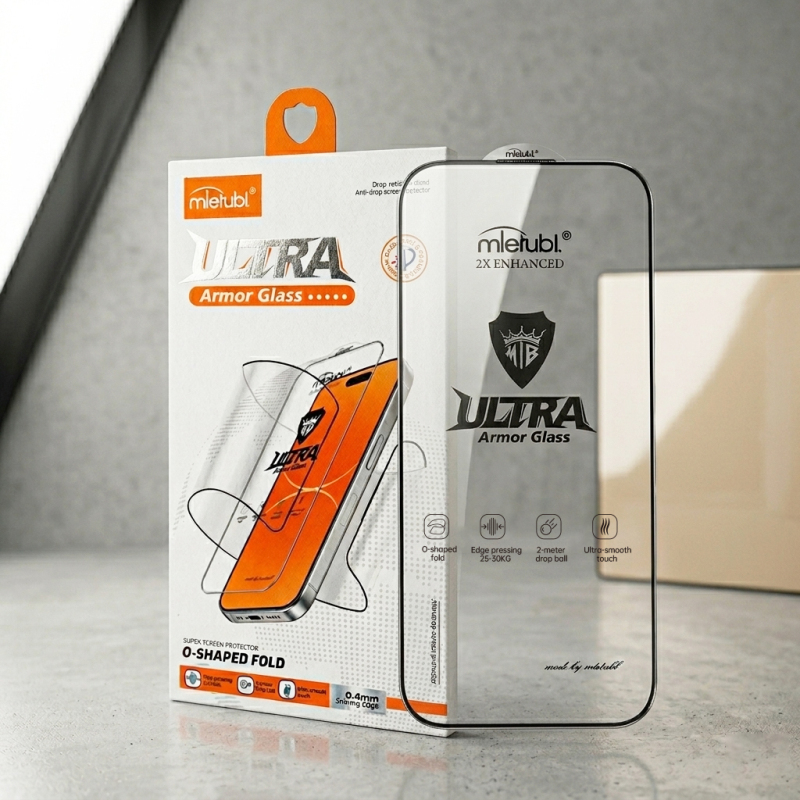
For impact and flexibility review, the available product data includes a steel-ball impact test using a 64 g ball from approximately 2 m. The glass is also described as capable of O-shaped folding under a stated “10 break 1” test standard. Because that wording may require procedural clarification, buyers should request the exact test method, sample quantity, failure definition, and pass threshold before treating it as an acceptance requirement.
Representative testing can include multiple target phone models, several pieces from the sample lot, and installation by the same process expected at retail or distribution level. This may expose model-specific issues that a single laboratory-style specimen does not show.
Set output acceptance before production
Fit is a finished-output decision, not only a dimensional check. The product uses real-device sizing data for its fine printed border, aiming to extend close to the screen edge without creating white edges or covering the display. Buyers should inspect alignment around the active display, speaker area, corners, and case-contact zones.
Define visible acceptance conditions before approving the sample. Useful checks can cover border alignment, trapped air, edge lifting, white-edge appearance, touch response, surface smoothness, and installation consistency. Where case compatibility matters, test the actual case combinations sold in the target market rather than assuming universal clearance.
The listed inspection method is GB/T2828.1. This identifies a sampling framework but does not by itself establish the buyer’s defect definitions. Critical, major, and minor defects, inspection stages, and acceptance levels should be confirmed in the purchase specification.
Common Questions
Is every screen protector tempered glass?
No. “Screen protector” identifies the product category, while glass refers to a particular material construction. Buyers should check the material field and configuration instead of relying on the category name.
Can one sample approve every phone model?
It should not be assumed. Screen shape, border alignment, speaker openings, and case clearance may differ by model, so representative devices should be included in validation.
What is the main risk when comparing samples?
The main risk is approving a sample that does not match the ordered build. Record the glass thickness, adhesive, border style, edge treatment, and target models used for approval.
Conclusion: approve the configuration, not the label
The difference between a screen protector and tempered glass is useful for category selection, but it is not enough for purchasing approval. Buyers should authorize the Xuanjia Anti-Drop Screen Protector only when a representative sample matches the intended material configuration and passes agreed fit, installation, and finished-output criteria.
About Mietubl
Mietubl is a Guangzhou-based mobile accessories brand whose name reflects its guiding idea: Make It Easier To Use, Better Life. With roots in the mobile accessories industry dating to 1998 and the MIETUBL brand registered in 2010, the company focuses on products that make everyday digital use simpler and more practical.
Its portfolio includes screen protectors, intelligent screen protector cutting machines, film materials, data cables, chargers, power banks, and audio accessories. By combining design, product development, manufacturing, and channel support, Mietubl works with distributors and retailers serving a broad range of mobile accessory needs, with products exported to more than 120 countries and regions.
For product information, samples, or distribution opportunities, contact Marketing@mietubl.com or visit www.mietubl.com.
Was this article helpful?
Your feedback helps us improve future articles.