
Do not choose between tempered glass and hydrogel by material name alone. For the products reviewed here, the stronger verifiable case belongs to a tested tempered-glass sample, while no equivalent hydrogel test data is available. Buyers should therefore validate the exact protector, adhesive configuration, phone model, and acceptance standard before approving a bulk order.
Make the Decision From Test Evidence, Not Category Claims
A useful sourcing decision separates a product-specific result from a broad material claim. Mietubl’s Xuanjia Impact-Resistant Protector is specified with reinforced high-alumina glass and has documented sample-level results including a 2-meter, 64-gram steel-ball impact test. Its glass is also described as capable of O-shaped folding under the stated test standard.
These facts provide an evidence base for evaluating that tempered-glass model. They do not prove that every tempered protector outperforms every hydrogel protector, particularly because the supplied information contains no comparable hydrogel construction or impact results.
- Prefer comparable evidence: Request the same drop or impact procedure for both candidate materials.
- Test production-representative samples: Decorative samples or unmatched prototypes may not reflect the final material stack.
- Confirm phone-model compatibility: Glass, adhesive thickness, curvature, and screen geometry must be evaluated together.
- Define acceptance before testing: Specify what counts as acceptable protector damage, edge condition, display quality, and phone-screen protection.
Validate Material Compatibility on the Exact Phone Model
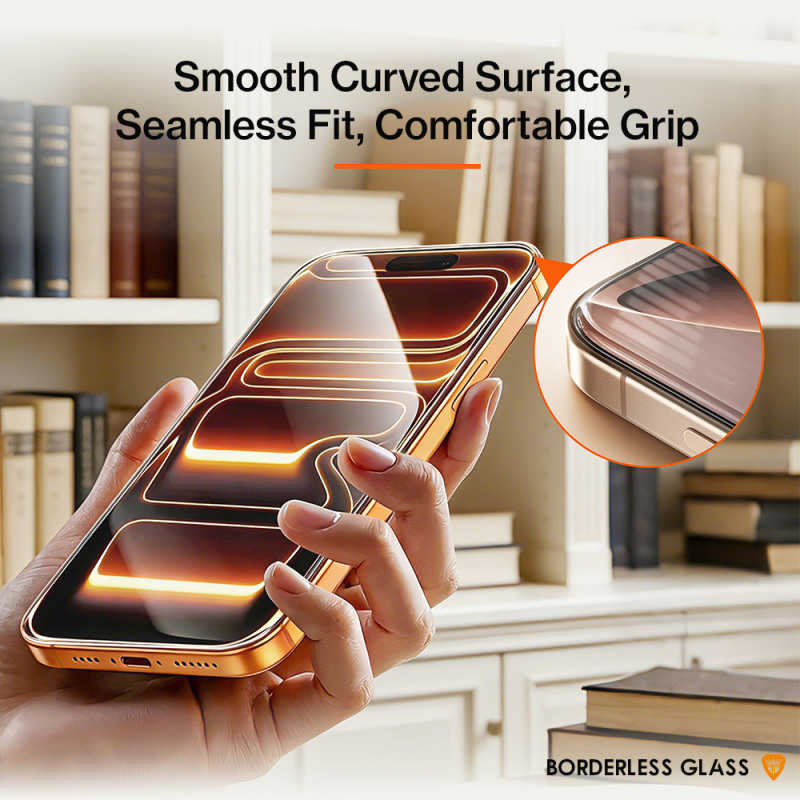
The HD Borderless Protector illustrates why the complete construction matters. Its approved configurations include high-alumina glass in 0.4 mm and 0.25 mm versions, with different antistatic AB adhesive thicknesses and different curvatures. A result from one version should not automatically be applied to another.
For sample approval, buyers should confirm the requested phone-model list and test each relevant construction on genuine or dimensionally representative devices. Check edge alignment, case interaction, earpiece positioning, touch response, and whether the adhesive follows the screen surface consistently.
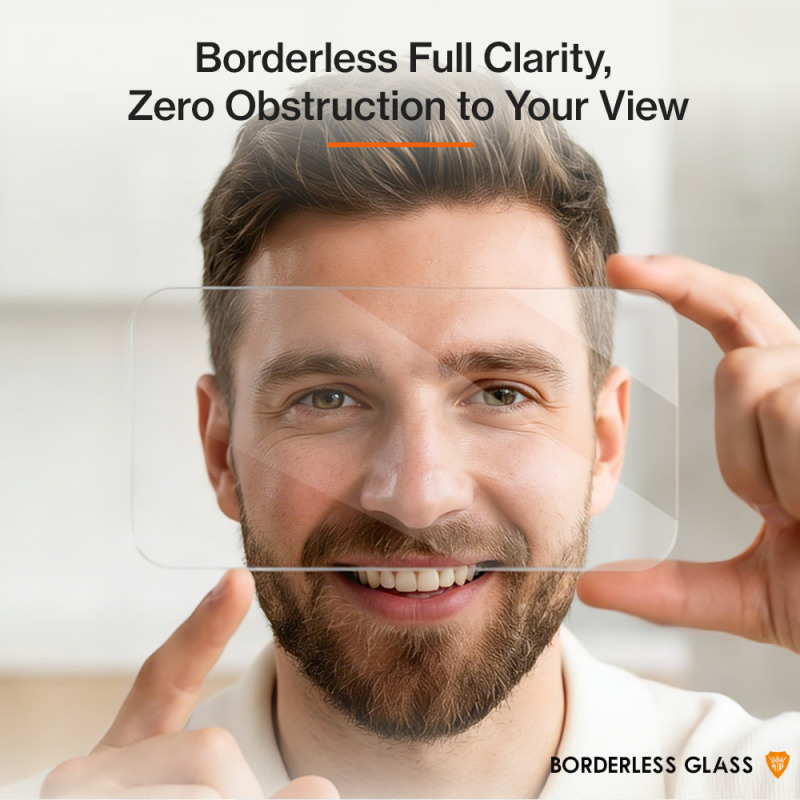
The borderless design removes the conventional printed black edge to avoid covering the display area. That buyer value should be verified by viewing test patterns near all four screen boundaries rather than judging fit from an inactive screen.
Use Representative Samples for Drop and Impact Testing
A representative sample should match the intended bulk order in glass configuration, adhesive, curvature, surface treatment, earpiece structure, and model dimensions. If OEM or ODM branding and packaging are required, the protective packaging should also be included when evaluating handling and transit damage.
Use a written test plan that records device model, sample quantity, impact tool, mass, height, impact location, orientation, number of repetitions, and result. When comparing tempered glass with hydrogel, apply the same procedure to both. Otherwise, differences in fixtures or impact locations can make the comparison unreliable.
Consider separate tests for center impact, edge impact, installation handling, and normal abrasion. The HD Borderless Protector is positioned for resistance to daily scratches, wear, and minor collisions, while the Xuanjia model carries the more specific impact-testing evidence. These products should not be treated as interchangeable merely because both belong to the phone-protector category.
Set Output Acceptance Before Approving the Order
Drop resistance should be only one part of acceptance. A protector that survives an impact but blocks the display, lifts at the edge, or disrupts normal operation may still be commercially unsuitable.
- Impact outcome: Record protector cracking, chipping, detachment, and the condition of the underlying screen.
- Fit and coverage: Confirm that the protector reaches the intended boundaries without creating visible obstruction or case interference.
- Display and touch: Check clarity, color presentation, brightness, and touch response across the full active area.
- Earpiece execution: For the HD Borderless Protector, inspect the integrated dust mesh for alignment, attachment, cleanliness, and acceptable sound output.
- Repeatability: Approve the sample only if results remain consistent across the agreed sample set and phone models.
Photographs, test records, and signed limit samples can help align buyer and supplier expectations before production inspection.
Common Questions About Protector Validation
Does tempered glass always provide better drop protection?
No category-wide conclusion can be supported from the available data. A tested tempered-glass model has specific impact evidence, but buyers need equivalent hydrogel results before making a direct material comparison.
Can one sample represent every phone model?
It should not. Different screen shapes and protector configurations may require different glass thicknesses, adhesive layers, or curvatures, so representative models should be sampled separately.
Should cracking automatically mean the sample failed?
That depends on the predefined acceptance standard. Buyers should state whether protector cracking is acceptable when the phone screen remains protected and whether edge chips, detachment, or touch changes constitute failure.
Conclusion
For the current evidence set, approve a tempered-glass option only on the strength of its exact tested construction, not on the material label itself. If hydrogel remains under consideration, obtain a production-representative sample and run the same documented tests before making the final procurement decision.
About Mietubl
Mietubl is a Guangzhou-based mobile accessories brand whose name reflects its guiding idea: Make It Easier To Use, Better Life. With roots in the mobile accessories industry dating to 1998 and the MIETUBL brand registered in 2010, the company focuses on products that make everyday digital use simpler and more practical.
Its portfolio includes screen protectors, intelligent screen protector cutting machines, film materials, data cables, chargers, power banks, and audio accessories. By combining design, product development, manufacturing, and channel support, Mietubl works with distributors and retailers serving a broad range of mobile accessory needs, with products exported to more than 120 countries and regions.
For product information, samples, or distribution opportunities, contact Marketing@mietubl.com or visit www.mietubl.com.
Was this article helpful?
Your feedback helps us improve future articles.